Dissecting My Confusion: Support-Vector Machine
A walk through SVM, kernel functions and the kernel trick, and why their names confused me more than the math.
In this article I work through SVM, kernel functions and the kernel trick, with a small example of how points in 1D become separable in 2D. I found that the terminology confused me more than the math did.
In science, I find that terminology full of colloquialisms rarely makes things clearer and usually causes confusion. Biology has terms like knock-out, knock-down, knock-in and junk DNA, and you can find plenty more if you are patient. It happens even more in Computer Science and related fields. Here I want to play with SVM, examine the confusion it caused me, and hopefully use that to clarify the concept.
The name
SVM is an absolutely confusing term. I find it hard to believe that the word “machine” was chosen for this algorithm. Why not “support-vectors assisted classification”, with “support-vectors” as one hyphenated word? It would have made a world of difference.
The math
This article does a good job of explaining the math behind SVM.
SVM is a constrained optimization problem. Here is the definition of the objective:


It is equivalent to the dual form:

It may not be obvious from the objective, but the bottom line of this problem is to find the optimal Lagrange multiplier (a). That is done through gradient descent, just like in deep learning. You can learn more in this video.
So far so good. The math needs serious mathematical knowledge, but I would still say it is fairly straightforward compared to the choice of terminology.
Kernel functions
Now for kernel functions. Sorry for complaining so much, but I don’t understand why they are called “kernel” functions. They could be called transformation nucleus functions, or transformation core functions. That makes infinitely more sense, because “transformation” is the keyword here.
The problem then becomes optimizing a function with some transformation applied, so that we can separate the data with a line, albeit in more dimensions. As a side note, I find it cool that the equivalent of a line in 1D is a dot, in 3D a plane, in 4D a 3D space, in 5D a 4D space, and so on.
Still, it is hard for me to imagine how points in one space can be linearly separated in a space with more dimensions. This example helped me.
Say the x values [-3, -2, 2, 3] have the label 1, and the values [-1, 1] have the label -1. Now transform them into two dimensions with this rule:

The points become (-3, 9), (-2, 4), (2, 4), (3, 9), (1, 1) and (-1, 1):
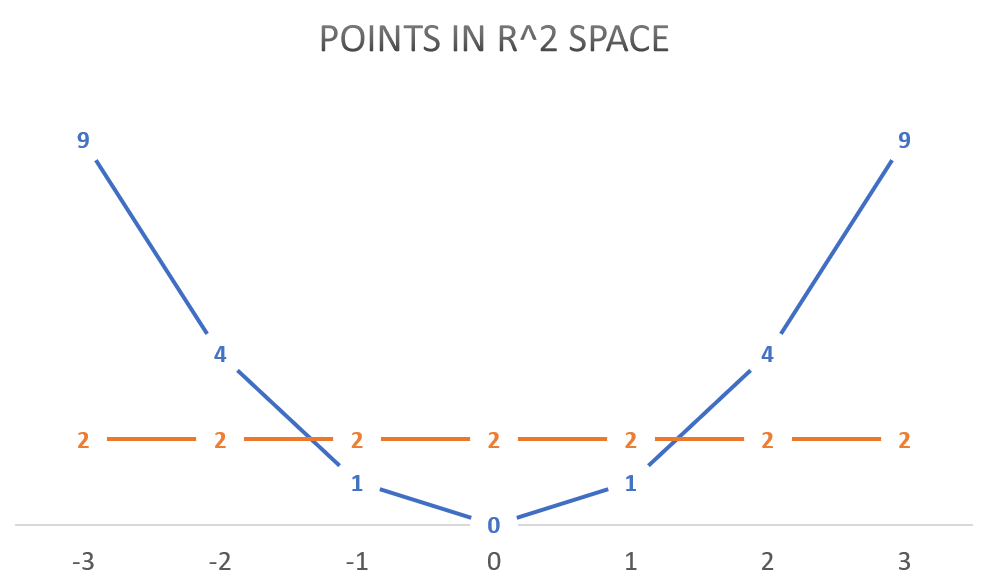
Clearly, the line where the second dimension equals 2 separates these points correctly. Now let’s transform this line back into the original 1D space with the reverse rule:

It gives us -√2 and √2. Essentially these are just two dots on the line:
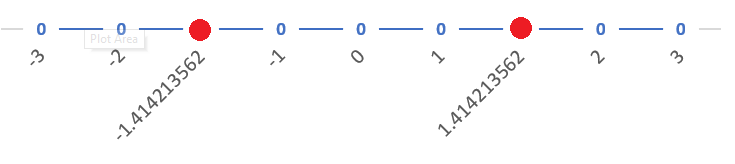
So two dots in 1D correspond to a line in 2D, which I find really interesting and almost mind-blowing.
The kernel trick
Back to kernel functions and the term “kernel trick”, which I also don’t like. As I said at the beginning, colloquialisms in scientific terminology usually take away from clarity.
The kernel trick is explained really well in this article. Let me take a step back, though. The kernel trick means that instead of transforming data to higher dimensions with a mapping function and then taking dot products, we can compute the kernel function directly. That can greatly simplify the calculation. To my mind, “kernel simplification” would have been a better name.
Conclusion
The math behind SVM is pretty advanced, but it was the choice of terminology, more than the math, that caused me a great deal of confusion. Analyzing my confusion helped me grasp the concept better, and I hope it helped you too.
最初发表于: 原文